


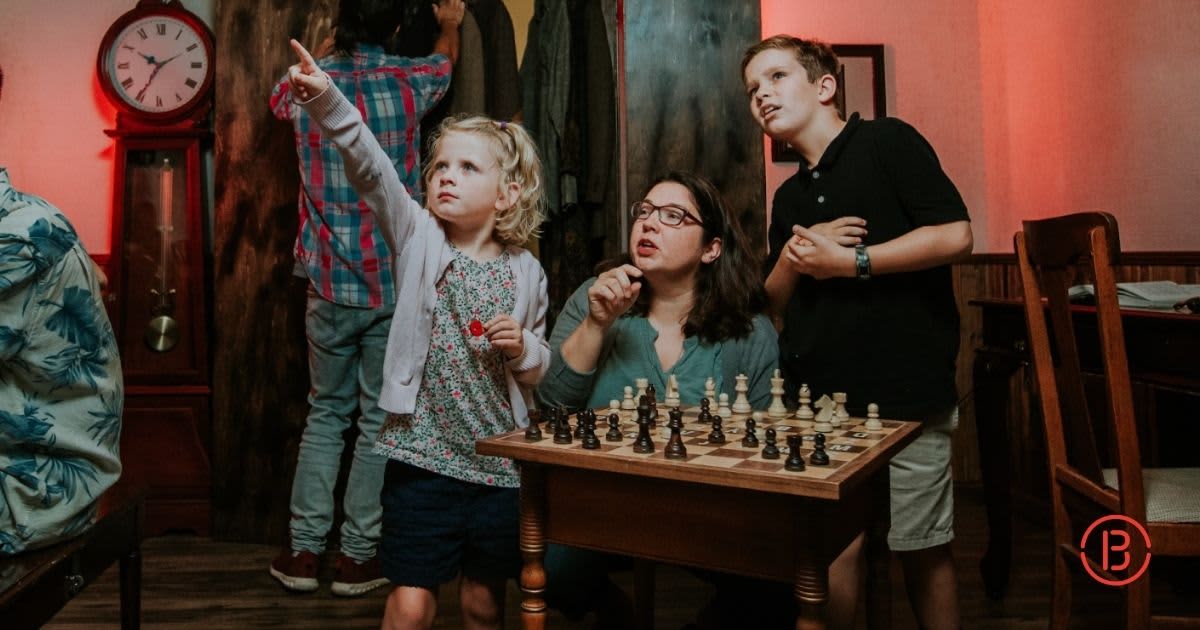

5 Lessons Kids Learn from Escape Rooms
Posted on April 3, 2026
by Faith Neece
by Faith Neece
At first glance, escape rooms look like pure entertainment: a locked door, a ticking clock, and a room full of puzzles waiting to be solved.
But watch a group of kids play one, and you’ll see something else happening. They’re testing ideas, sharing discoveries, encouraging each other, and learning how to push through challenges together.
Escape rooms combine logic, creativity, and teamwork in a way that few activities can. While kids are busy having fun, they’re also building skills that help them in school, friendships, and everyday life.
Here are five powerful lessons kids learn from playing escape rooms.
1. Teamwork and Collaboration
Escape rooms can’t be solved alone. Players have to work together, share information, and combine their discoveries to move forward.
Kids quickly learn that success comes from listening to each other, dividing up tasks, and communicating clearly. One person might find a clue while another figures out how to use it. When those pieces come together, the whole team progresses.
These collaboration skills are the same ones kids rely on in group projects, sports teams, and friendships.
2. Critical and Strategic Thinking
Escape rooms are packed with puzzles that require observation, logic, and pattern recognition.
Kids practice:
- Identifying connections between clues
- Testing ideas and hypotheses
- Thinking through problems step-by-step
This kind of analytical thinking mirrors the skills used in STEM subjects like math, science, and engineering. The difference is that in an escape room, the learning feels like a game.
Instead of memorizing answers, kids are learning how to think.
Instead of memorizing answers, kids are learning how to think.
3. Perseverance and Resilience
Not every puzzle is solved on the first try.
Escape rooms challenge players to keep going even when they feel stuck. Kids learn that frustration is part of the process—and that persistence often leads to breakthroughs.
That moment when a puzzle finally clicks teaches an important lesson: struggling with a problem doesn’t mean failure. It means you’re getting closer to the solution.
Building resilience in a fun environment helps kids develop the confidence to tackle difficult problems elsewhere.
Escape rooms challenge players to keep going even when they feel stuck. Kids learn that frustration is part of the process—and that persistence often leads to breakthroughs.
That moment when a puzzle finally clicks teaches an important lesson: struggling with a problem doesn’t mean failure. It means you’re getting closer to the solution.
Building resilience in a fun environment helps kids develop the confidence to tackle difficult problems elsewhere.
4. Time Management and Focus
Escape rooms are played against the clock. Players must decide where to focus their attention and how to use their limited time wisely.
Kids learn to:
Kids learn to:
- Prioritize tasks
- Shift strategies when something isn’t working
- Stay focused under pressure
These skills translate directly to real-world situations like completing homework, studying for tests, or balancing multiple responsibilities.
5. Confidence and Accomplishment
Few things feel as satisfying as unlocking the final clue and escaping the room.
Every solved puzzle reinforces the idea that their ideas matter and their efforts pay off. Kids leave the experience feeling proud of what they accomplished together.
That boost in confidence often carries into other areas of life—from schoolwork to trying new challenges.
Every solved puzzle reinforces the idea that their ideas matter and their efforts pay off. Kids leave the experience feeling proud of what they accomplished together.
That boost in confidence often carries into other areas of life—from schoolwork to trying new challenges.
More Than Just a Game
Escape rooms may look like entertainment, but they offer something much deeper. They encourage kids to think critically, communicate openly, and stay resilient when faced with a challenge.
And the best part? Kids develop these skills while laughing, exploring, and celebrating each small victory along the way.
Ready to put those skills to the test? Book a game here.
And the best part? Kids develop these skills while laughing, exploring, and celebrating each small victory along the way.
Ready to put those skills to the test? Book a game here.